What "Dressing Your Age" Really Means in Your 50s — and Why You Can Ignore It
"Dress your age." Three words that have done more damage to women's closets than any other phrase in the English language.
Because here's the thing nobody who says it can ever explain: what does 53 look like? What's the official outfit? Where's the rack at the department store labeled "for women who are exactly 56 and three months"? It doesn't exist. The rule was never about clothes. It was about keeping women in their place, and the place got smaller every year.
Where the rule came from
"Age-appropriate dressing" was invented in an era when a woman over 50 was assumed to be done — done having children, done being looked at, done being interesting. The clothes followed the assumption. Long sleeves. High necks. Below-the-knee. Polyester florals. Beige cardigans. The wardrobe of someone who has agreed to disappear politely.
Then somebody noticed that 50 isn't done with anything. 50 is, statistically, the start of the second half. The kids are launched. The career might be peaking. The body knows itself. The opinions are sharper. And suddenly the "age-appropriate" wardrobe looks like what it always was — a costume designed to make a powerful woman look harmless.
The real rule, decoded
When someone tells you to dress your age, here's what they're actually saying:
Don't draw attention to your body. (Translation: your body isn't ours to look at anymore, so cover it.)
Don't try too hard. (Translation: trying is unseemly in a woman past 40.)
Don't wear that — it's for younger women. (Translation: there's a list, and you've been moved to a different list.)
Be tasteful. (Translation: be quiet.)
Notice that none of it is about you. None of it asks what you like, what fits your life, what makes you feel like a person when you put it on. It's all about managing other people's comfort with the fact that you exist past a certain age.
What you can wear in your 50s (the real list)
Whatever you want.
The bright color. The mini skirt if you have the legs and the nerve. The bare arms. The leather jacket. The vintage band tee. The silk slip dress. The crop top under a blazer. The white jeans after Labor Day. The whole back catalog of things you were told not to.
You can also wear the long cardigan and the loafers and the elastic waist if those are what you actually love. The point isn't to be loud. The point is to choose for yourself.
The grey hair test
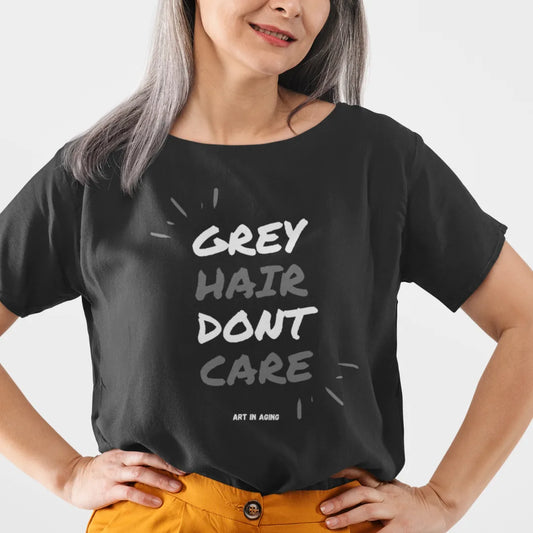
Here's a quick test. Would you wear this if your hair was its natural silver and you weren't trying to "look younger"? If yes, it's yours. If you'd only wear it because it's part of a strategy to perform youth, leave it on the rack.
The strategy is what's exhausting. The clothes are usually fine.
What changes when you stop "dressing your age"
You stop shopping in the wrong section. The "missy" department was invented to politely segregate women over 45. You walk past it. You shop the whole store. You also shop your daughter's closet sometimes, and your son's, and you discover that men's t-shirts fit better than half the things made for you.
You stop apologizing in fitting rooms. The mirror is a mirror. It is not a courtroom and it does not have an opinion on whether you've earned the right to wear yellow.
You start to notice that the women you actually find stylish — the ones in your neighborhood, in magazines, on the street — are almost never dressing their age. They're dressing their life. There's a difference. "Flattering" stops being a category. So does "appropriate."
The only rule worth keeping
If you put it on and you walk taller, it stays. If you put it on and your shoulders curl in, it goes. That's the whole rulebook for dressing in your 50s. Ignore the rest.
The women who do this look like the version of themselves that was buried under thirty years of "appropriate." Their friends ask what they did. The honest answer is always the same: I stopped listening.