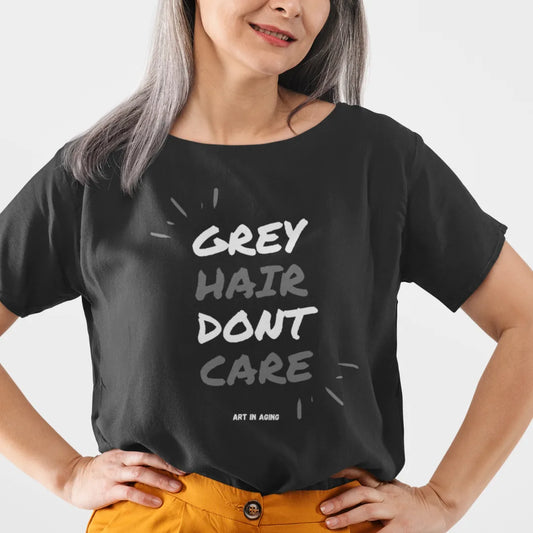
Why Women Are Choosing to Go Grey — And Not Looking Back
Something has shifted. A few years ago, letting your grey grow in was seen as giving up — on effort, on appearance, on staying relevant. Today, women are making the same choice in growing numbers, and most of them describe it not as a resignation but as a relief.
What changed? And why does this decision feel like so much more than a hair choice?
The Numbers Tell a Story
Searches for "going grey" and "grey hair transition" have grown steadily year over year. Silver hair hashtags on Instagram have accumulated hundreds of millions of posts. Facebook groups dedicated to embracing natural grey hair have hundreds of thousands of members.
This isn't a trend in the fashion-forward sense — something that will peak and fade. It's a cultural shift, driven by women who are done performing a version of themselves they no longer recognize.
What Women Say When You Ask Them Why
Talk to women who've made the switch and you'll hear the same things, over and over.
"I was spending so much money." Regular salon visits to cover grey can cost anywhere from $100 to $300 every six to eight weeks. That's $600 to $2,400 a year — for the rest of your life — to look like a slightly younger version of yourself.
"I was spending so much time." The appointments. The waiting. The maintenance between appointments. The anxiety when roots start showing at the wrong moment. Women describe going grey as getting hours of their life back.
"I felt like I was lying." This one comes up more than you'd expect. Women describe the constant covering as a form of performance — presenting a self that doesn't quite match who they are anymore. Going grey felt like telling the truth.
"I just got tired." Tired of the upkeep. Tired of caring so much. Tired of the gap between their inside experience and their outside appearance.
The Deeper Reason Behind the Decision
Here's what's actually happening beneath the surface: women in midlife are increasingly unwilling to spend their energy on other people's comfort.
The implicit social contract around grey hair has always been: hide it, because visible age makes other people uncomfortable. It signals that you're no longer young, no longer in a particular kind of market, no longer performing the role that culture assigns to women for their first few decades.
Refusing to hide it is, in a quiet way, a refusal of that contract.
It says: I know I'm getting older. Everyone can see it. I'm not pretending otherwise, and I'm not apologizing for it.
That's a significant thing to say. Which is why so many women describe going grey as one of the most psychologically liberating decisions they've made — not because grey hair itself is liberating, but because of what the decision represents.
The Transition Moment
What typically pushes someone from considering it to actually doing it?
For many women, it's seeing someone else. A photo online. A stranger on the street with beautiful silver hair. A colleague who went grey and looks more herself than ever. The moment of recognition: that could be me.
For others, it's a life event — a move, a milestone birthday, a shift in how they see themselves. A moment where they decide to stop postponing the version of themselves they actually want to be.
For others still, it's simpler: the roots are showing, the appointment costs what it costs, and suddenly the math stops making sense.
Whatever the trigger, most women who've done it say the same thing about what happened after: they wished they'd done it sooner.
What Doesn't Change
One thing worth naming: going grey doesn't mean giving up on looking good. The women who describe going grey as liberating are not describing a decision to stop caring about their appearance.
They're describing a decision to stop caring about a specific standard — the one that says looking older is inherently worse. Once that standard is gone, style actually becomes more interesting. Without the constraint of "look younger," the question becomes "what actually looks like me?"
Wardrobe. Skincare. Makeup. Jewelry. These all get reconsidered — not abandoned — when the underlying goal shifts.
The Community That Formed Around This
One unexpected outcome of this shift: women going grey found each other.
What started as Instagram hashtags became actual communities — spaces where women share their transition timelines, talk about the experiences that come with aging on your own terms, and find connection with people who understand what it means to stop shrinking.
The grey hair is often the entry point. But what keeps people in these spaces is the conversation underneath: about identity after 50, about style that reflects who you actually are, about what a good life looks like at this stage.
That conversation is valuable. And it deserves a good room to happen in.
The Silver Sister Community
Ready to find your people?
The Silver Sister Community is a space for women 50+ to talk about positive aging, grey hair, identity, and life on your own terms. Founding members lock in $27/month — forever.