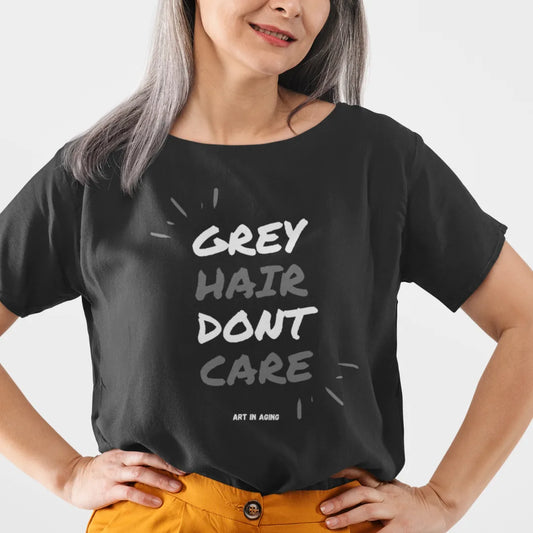
You've gone grey. Maybe it took months, maybe you're still in the thick of your grey hair transition, but somewhere along the way you decided to stop fighting it. Now comes the question that nobody warns you about: what the hell do you wear with it?
This isn't vanity. It's practical. Your grey hair is a completely different canvas than whatever color you were working with before. The rules have changed—and honestly, that's good news. Because unlike the years when you were trying to match colors to hair that wasn't even real, now you get to work with what you've actually got. And what you've got is striking.
Here's what you need to know: certain colors will make your grey hair sing. Others will make you look washed out, tired, or like you're trying too hard to prove something. The goal isn't to hide your age or play it safe. It's to look like the most alive, most present version of yourself. That's entirely different.
Why Grey Hair Changes Your Color Game
Your skin tone hasn't changed, but the contrast around your face has. When you had darker hair, it created a natural frame that pulled certain colors into prominence. Grey hair—especially if you've got a good amount of silver—is reflective. It bounces light. It changes what lands and what gets lost against your skin.
This is why colors that looked fine on you five years ago might feel off now. It's not that you've stopped being able to wear them. It's that grey hair requires intention. The good news: once you understand the basic logic, getting dressed becomes easier, not harder.
The pigment in your grey hair also affects which undertones in your clothing will harmonize with your face. If your grey is more silver-toned, you'll naturally gravitate toward different shades than someone whose grey is salt-and-pepper or ash-based. Neither is better. Both require slightly different approaches.
Jewel Tones: Your Most Reliable Friends
Jewel tones—deep, saturated colors with richness and depth—are where most women with grey hair find their sweet spot. We're talking sapphire, emerald, amethyst, ruby, and deep teal. These colors have enough weight and intensity that they don't compete with your hair; instead, they frame it and let it be the statement it actually is.
Why do these work so well? Because they have both depth and luminosity. They're not pale or washed out, so they don't fade into your skin tone or make you look like you're disappearing. At the same time, they're not so bright that they scream for attention. A rich jewel tone sits at a perfect middle point: it's confident without being aggressive.
The rule is simple: go deep and go saturated. A navy blue is better than a baby blue. A forest green beats sage. An eggplant wins over lavender. Your grey hair has earned the right to stand next to colors that match its own intensity.
Warm vs. Cool Undertones: Trust Your Gut (But Know the Logic)
You've probably heard this before, and it matters: knowing whether you have warm or cool undertones in your skin helps you pick colors that won't make you look sallow. But here's where it gets interesting with grey hair—your undertones might matter even more now because there's less color around your face to distract from how a shade is actually reading on you.
If you have cool undertones (think pink, red, or blue notes in your skin), you'll look best in jewel tones that skew cool: sapphire, emerald, cool purples, cool greys, and blacks. Warm undertones (peachy, golden, olive) will light up with warm jewels: amber, warm rust, warm burgundy, warm greens like olive, and warm-toned neutrals like caramel and cream.
The easiest way to figure out which camp you're in: hold a piece of silver next to your face, then try gold. One will look natural and complementary. The other will look slightly off. That's your answer. Gold = warm. Silver = cool. Simple.
That said, plenty of women have mixed undertones or neutral undertones, and they can honestly wear anything if the saturation and depth are there. The jewel tone rule matters more than the warm-cool rule. If you're picking between a washed-out color in your "right" undertone family and a gorgeous jewel tone in the "wrong" one, pick the jewel tone every single time.
Neutrals That Actually Work (They're Not What You Think)
Black, white, cream, grey, and brown aren't boring. In fact, with grey hair, they become tools. The key is understanding that not all neutrals are created equal.
Black is your friend. It's not depressing or harsh—it's clean, it's sharp, and it makes grey hair pop like nothing else. A black blazer, black jeans, a black sweater: all excellent choices. The contrast is high enough that it actually flatters.
Charcoal and slate grey are softer than black but still have substance. They won't compete with your hair the way a bright color might, and they're less stark than true black if that matters to your sensibility.
Cream and ivory work well, especially if you have cool-toned skin or if your grey is very silvery. They're lighter without being washed out. Just avoid yellowed whites or beiges if you have a lot of silver in your hair—the contrast can feel slightly off.
Brown and tan are trickier. They work beautifully if they're rich and warm (like chocolate or caramel) and if they match your undertones. But pale, cool-toned browns can sometimes clash with grey hair. If you love brown, go dark or go warm, not both light and cool.
The trick with neutrals: pair them with your grey hair as the statement, or layer them with a jewel tone accent. A black sweater with a sapphire scarf. A cream top with emerald bottoms. Never put your grey hair next to a pale, washed-out neutral and expect it to shine—because it won't.
Colors to Approach With Caution
Some colors require more consideration with grey hair. This doesn't mean you can't wear them. It means you need to be intentional.
Pastels are the most common pitfall. A pale pink, pale blue, or pale yellow will drain the life out of your face and make your grey hair look faded by comparison, not enhanced. If you love pastels, you need to be in a saturated version (a deeper rose, a richer sky blue) or pair it with something darker to create balance.
Grey itself requires strategy. A grey sweater that matches your hair exactly? You're going to look monochromatic and flattened. Grey can work beautifully if it's either much darker or much lighter than your hair, or if it's paired with a bold accent color that brings your face back into focus.
Beige and khaki are often too close to skin tone, especially as we age and skin tone shifts slightly. They can blend you away rather than showcase you. If you adore these colors, go richer (camel, tan) or pair them strategically with jewel tones.
Bright, neon colors can work, but they're shouty. If you're the type who loves a statement, great. If you're more understated, they'll probably feel wrong. The issue isn't that you "can't" wear them—it's that they fight for attention against your hair rather than complement it.
Building Outfits That Actually Work
Knowing which colors flatter grey hair is one thing. Building an outfit is another. Here's a simple framework that works.
The jewel tone anchor: Start with a jewel tone as your main piece. This could be a sweater, a blouse, a dress, or a blazer. Something that's going to frame your face and set the tone. Let your grey hair be the secondary statement—still visible and beautiful, but not competing.
Neutral foundation: Build from there with neutrals. Black jeans with a sapphire top. A cream blouse under an emerald cardigan. Grey trousers with a jewel-toned sweater. The neutrals give your eye somewhere to rest and let the jewel tone do its job.
The accent: If you're wearing two neutrals (like black and cream), add a jewel tone accent: a scarf, a bag, shoes, jewelry. Something to bring intentionality to the outfit and give your grey hair something to sing against.
The beauty of this system is that it's not restrictive—it's actually liberating. Once you get the bones right, you can rotate pieces endlessly. It's not about having a perfect wardrobe. It's about understanding how the pieces you have can work together.
Testing Colors: The Practical Part
Theory is nice, but fabric against your actual face is what matters. Here's how to actually figure out what works for you without overthinking it.
Hold clothing up to your face in natural light—not fluorescent dressing room light, which lies about everything. Notice what happens to your face. Do you look brighter or duller? Does the color seem to sit on top of your skin or sink into it? Do you look more awake or more tired?
The color that makes you look brighter and more present is the color that works. That's it. There's no rule that overrides how something actually looks on you.
If you're shopping online or can't see something in person, order it. Try it on in your own light. If it doesn't work, return it. The few minutes of effort beats spending money on colors that make you feel off when you wear them.
One More Thing: Your Whole Picture
Color is only one variable. The other variables—fit, fabric, cut, your own confidence level—matter just as much. A perfectly colored sweater that doesn't fit right will still feel wrong. A jewel tone top made of scratchy synthetic fabric won't make you feel good even if the color is theoretically perfect.
Your grey hair is bold. It demands pieces that are equally confident: good fabric, intentional cuts, items that fit your actual body rather than some imagined version of it. Pair that with colors that complement rather than compete, and you've got an outfit that works.
Getting dressed becomes simpler once you understand the logic. It's not arbitrary. Your grey hair isn't a limitation—it's actually a gift in the wardrobe department, because it forces you to be intentional, and intentionality always looks better than accident. Wear the colors that make you feel like yourself. That's the only rule that actually matters.