By your 50s, you've spent decades making a choice every four to six weeks: dye your hair or live with the grey showing through. You know the routine. The time at the salon. The chemical smell. The expense that adds up to thousands of dollars over a lifetime. The constant maintenance, the touch-ups, the anxiety if you're traveling and your roots start showing before you planned. If you're thinking about stopping, here's what nobody tells you: your 50s might actually be the easiest decade to do it.
Related: see our newer guide on The Freedom of Not Giving a Damn: Why Your 50s Can Be the Most Liberating Decade.
Not because you suddenly stop caring what people think—that's a lie we tell ourselves. But because of something more practical: by 50, you've usually accumulated enough grey that the transition is actually manageable. Your hair has some color variety already, which helps blend the regrowth. You've likely settled into a style that works for you, which means you're not also relearning your look from scratch. And maybe most importantly, you have enough life experience to weather the opinions of people who don't matter.
Why Your 50s Are Actually the Sweet Spot
There's a biological reality here worth acknowledging. If you started going grey in your 40s or even earlier, by 50 you're probably 30-50% grey already—assuming you've been dyeing it. That percentage is critical. It means you're not starting from a place of nearly all dark hair with a shocking stripe of silver. The regrowth blends more easily with hair that's already got dimension and texture variation. You're not creating the stark, obvious line that makes some women in their 30s and 40s decide it's too visible to manage.
There's also a practical life advantage at 50. Your schedule is often more flexible than it was in your 40s. You might not care about impressing a boss quite as much, or you're in a position where your competence is already well-established. If you have kids, they're probably old enough that they're not asking you why you suddenly look different. And if you don't, you've never had to negotiate that conversation anyway. Your intimate relationships are either stable or you're past the point of performing femininity for strangers. That freedom is real, and it matters more than we admit.
The financial piece shouldn't be overlooked either. By 50, most women are tired of the money. The salon appointments, the at-home dye kits, the expensive color-protecting shampoos, the damage repair treatments—it's a tax on your time and your wallet that you've been paying for decades. Making the switch to natural grey in your 50s means you get back both for the next several decades of your life. That's not trivial.
The Practical Realities of the First Few Months
Let's be honest about what actually happens when you stop dyeing. The first phase is awkward, but it's not usually a disaster. Your dark dyed hair and your natural grey roots create that two-tone effect that has a name: the "salt-and-pepper" or "rooted" look. In your 50s, this doesn't look like you're neglecting yourself—it looks intentional. And increasingly, it looks like you're part of the silver sister movement, which has enough cultural momentum now that people recognize what you're doing rather than assuming you've given up.
The transition usually takes anywhere from six months to a year, depending on how fast your hair grows and how much grey you're working with. During this time, you have options. Some women lean into it fully and let the roots grow out. Others get a short cut that minimizes the contrast. Some use temporary color on their dyed lengths to fade it gradually, or get strategic highlights to blend the two colors together. There's no single right way, and by 50, you're old enough to know that.
One thing that genuinely helps: knowing what to expect. Your hair texture might change slightly as the grey comes in. Grey hair is often coarser and can be drier. Your styling routine may need adjusting. You might need a grey hair shampoo that keeps your silver bright instead of yellowed. These aren't obstacles so much as things to plan for. By your 50s, you've adjusted your body and your life to change enough times that you know how to troubleshoot.
The Psychological Shift Nobody Talks About
Here's what happens that's rarely discussed: going grey in your 50s forces a reckoning with who you actually are versus who you've been performing as. You've been dyeing your hair for so long—possibly 20, 30, or more years—that you might have forgotten what your natural color even looks like. Some women find that their natural grey is actually more flattering than the color they've been maintaining. It's softer. It suits their skin tone better now than it did when they were younger. It makes them look less tired, less like they're fighting their biology.
Others find that they look more like themselves. Not prettier, not younger—just more like the person they actually are. There's something grounding about that. After 50 years of living, you have some clarity about what matters and what doesn't. Your grey hair becomes part of your actual appearance rather than something you're managing or hiding. That shift is psychological, but it's also surprisingly physical. You might find yourself standing taller. You might stop with certain apologetic gestures. You might stop qualifying your opinions with "I might be wrong, but…"
There's also a practical confidence element. If you can make it through the awkward transition phase—which, let's be clear, is only awkward if you decide it is—you're proving something to yourself. You're proving that you can do something that goes against cultural pressure and come out the other side fine. Better than fine. That carries over. It makes the next boundary easier to set, the next "no" easier to say, the next time you choose yourself over an external expectation.
Addressing the Specific Worries
Will it make me look older?
The short answer: not necessarily, and probably less than you think. The longer answer involves understanding that aging is about more than hair color. You can be 55 with vibrant silver hair and a healthy glow and look younger than someone who's 50 with dark dyed hair and exhausted skin. The key is everything else—skincare, fitness, how you carry yourself, whether you're getting enough sleep and water. Grey hair doesn't age you. Neglecting yourself ages you. And honestly, many women report that they feel so much lighter and more energetic after going grey—because they're no longer spending mental and physical energy on maintenance—that they actually look fresher. If you're worried about whether grey hair makes you look older, read the actual research. The answer is more nuanced than you've been told.
What if my workplace is conservative?
Fair question. By your 50s, you know your workplace. You know whether your boss is someone who cares about how you look, or whether she cares about your work. You know whether your industry is visual or merit-based. You also know that you've built enough of a track record that one change in your appearance isn't going to undo it. If you're genuinely concerned, you can transition gradually. Cut your hair shorter as you're going grey, which reduces the visibility of the regrowth line. Lean into a polished version of the look. Wear your grey hair like the choice it is, not like an accident. By your 50s, you have enough authority in the room to pull that off.
What about dating or being found attractive?
This one deserves honesty. The cultural messaging is that grey hair makes you invisible or less desirable. For some men, it does. You will lose interest from some people. You will also find that you're more interested in people who are attracted to you as you actually are, rather than as you've been performing. By your 50s, you've probably had enough relationships to know that attractiveness is as much about confidence and authenticity as it is about appearance. And there is a specific kind of attractiveness that comes with owning your age. It's not for everyone, but it's there.
Making the Transition Practical
If you've decided to do this, here are the concrete steps. First, get a good haircut from someone who understands grey hair. Not everyone does. You want someone who gets that grey hair needs different styling because of its texture. Second, invest in decent products. Your grey hair will be coarser, and it deserves care. Third, be strategic about the timing. If you can transition during a season when you're not dealing with major life events, that helps. Fourth, prepare for people to notice and comment. Not all comments will be supportive. The ones that aren't tell you more about the person commenting than about you.
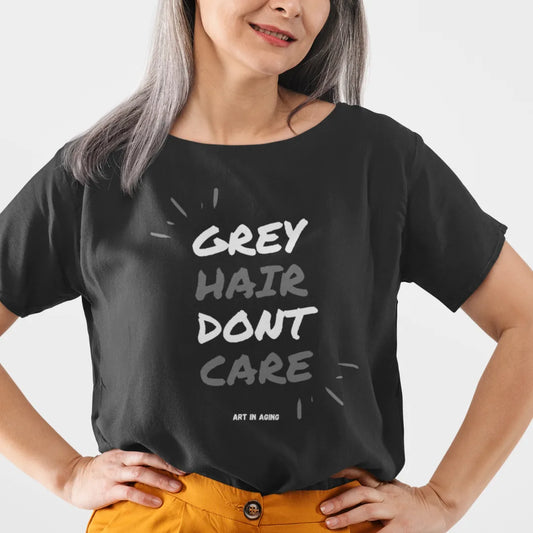
Consider getting some grey hair shirts or other pieces that make you feel good during the transition. Some women find that having something that explicitly celebrates their choice helps them feel more intentional and less self-conscious. It's a small thing, but it works. You might also want to connect with people who are doing the same thing. The silver sister community is full of women at every stage of this transition. Reading their stories, seeing their photos, knowing you're not alone—that matters more than you'd think.
The Long View
By your 50s, you've likely learned that the things you worried about in your 40s didn't actually matter. The opinions you thought were permanent turned out to be temporary. The people you thought you had to impress moved on. Your 50s are a good time to make a decision that's for you, not for an imagined audience. Going grey is one of those decisions. It's visible, which makes it feel bigger than it is. But it's also manageable, practical, and increasingly normal among women over 50 who've decided they'd rather be themselves than perform.
Your 50s might be exactly the right time because you have the maturity to handle the transition, the biological advantage of already being partially grey, and the life experience to know that you'll be fine on the other side. The awkward phase is temporary. The freedom is permanent.