There's a Tax Nobody Warned You About
It's not on your paycheck. It's not deducted from your bank account. But it's real, and you've been paying it for years.
The moment a woman turns 50, society starts discounting her. Her opinions get talked past in meetings. Her presence goes unremarked in rooms where she used to command attention. Salespeople look through her. Doctors talk to her like she's a child. Algorithms stop serving her ads for anything interesting and start pushing her walk-in tubs and funeral planning.
This is the age tax. And women are paying it in confidence, in opportunity, in visibility — every single day.
The Youth Obsession Has a Price — And Women Pay It
Western culture has a problem. It treats youth as currency and aging as debt. For men, grey hair is distinguished. For women, it's been treated as something to fix, hide, apologize for — until very recently.
Think about the language we've been handed. "Anti-aging." As if aging is the enemy. As if the goal is to trick your body into forgetting what year it is. The beauty industry has made billions on this premise: that the natural progression of a woman's life is something to be fought, concealed, and ultimately defeated.
And the message underneath all of it? You are worth more when you're younger. Your value depreciates with time.
That's not just insulting. It's a lie.
Invisible — Or So They Think
Many women over 50 describe the same experience. The sudden invisibility. The way people look past you on the street, in a restaurant, in a store. The way you stop being treated as someone whose opinion, style, and presence matter.
Here's the thing about invisibility, though. It only works if you believe it.
The women who are rewriting this story — who are showing up fully in their grey, their wrinkles, their unapologetic realness — they're not invisible. They're magnetic. They've stopped shrinking themselves to fit a standard designed to expire them, and in doing so, they've become some of the most interesting, vital, compelling women in any room.
Society's blind spot is not your problem to solve. It's theirs.
The Workplace Version Is Particularly Brutal
Let's call it what it is. Women over 50 face age discrimination in hiring, promotion, and pay — often compounded by gender discrimination that never went away in the first place. Companies quietly push out experienced women in favor of younger hires they can pay less and mold more easily.
Studies show that older job seekers send significantly more applications for every interview they receive compared to their younger counterparts. The skills, the institutional knowledge, the decades of navigating complexity — none of it gets weighted fairly.
Meanwhile, those same companies are likely losing their most capable people. Women in their 50s and 60s often represent the peak of professional capability: deep expertise, emotional intelligence, perspective, resilience. The age tax costs organizations as much as it costs the women paying it.
The Medical System Isn't Exempt
Women already know the pain of being disbelieved by doctors. Add age to gender, and it compounds. Symptoms get dismissed. Concerns get minimized. "That's just part of getting older" has become a medical system's way of saying: we're not going to look any harder.
Women are reporting health complaints later in life at rates that should alarm public health systems — and they are being heard less than they deserve. Pain gets undertreated. Conditions get missed. The assumption is that age explains everything, so nothing needs to be examined too carefully.
This is the age tax in its most dangerous form. And women are fighting back — by becoming fierce advocates for their own care, by finding physicians who listen, by demanding to be taken seriously.
Why "Anti-Aging" Is the Wrong Fight
Here's what's shifting. A growing movement of women has decided to stop playing the game entirely.
Not by pretending to be younger. Not by the exhausting maintenance of a persona that erases who they actually are. But by doing the more radical thing: showing up as themselves. Fully. Without apology.
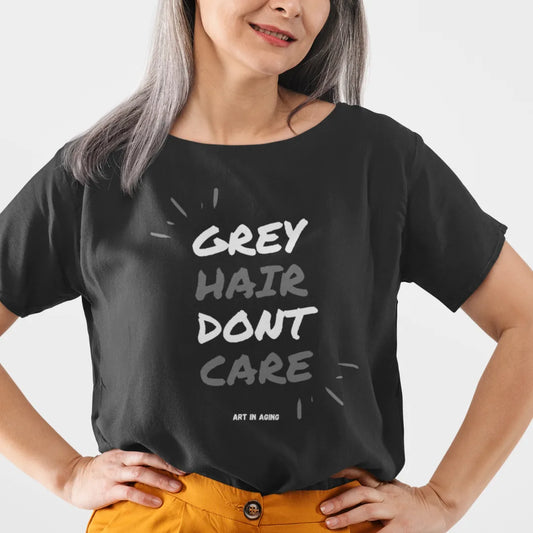
The silver hair isn't a surrender. It's a statement. It says: I know who I am. I earned this. I'm not performing youth for your comfort.
That's not defiance for its own sake. It's freedom. The kind that only comes when you stop caring more about other people's comfort than your own truth.
The Silver Sister Community Is Rewriting the Rules
You are not alone in this. Not even close.
Millions of women over 50 are choosing presence over invisibility, authenticity over performance, community over competition. They're sharing their experiences, celebrating each other's courage, calling out the systems that undervalue them — and building something better.
Art in Aging exists inside that movement. It's not just apparel. It's not just a brand. It's a community of women who've decided that this chapter of life isn't a consolation prize. It's the real thing. The one where you know yourself well enough to stop pretending.
The age tax is real. But you don't have to keep paying it.
Join the Conversation
If you're ready to stop apologizing and start showing up fully — in your grey, in your wisdom, in your complete self — you belong here.
The Art in Aging community is where silver sisters gather. We celebrate each other, support each other, and remind each other that this stage of life is worth dressing up for.
Come in. The grey is gorgeous, and so are you.