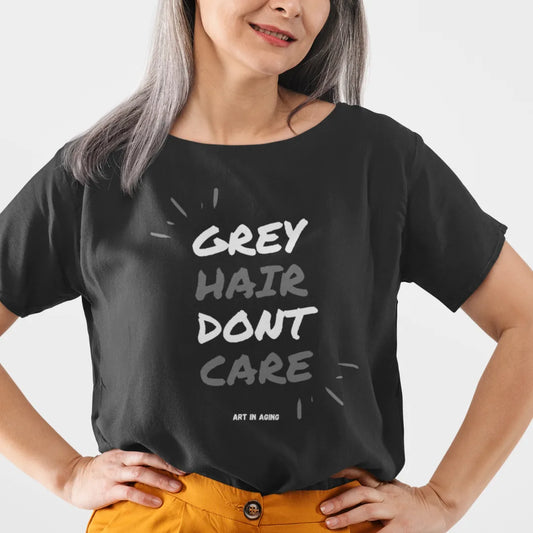
I started dyeing my hair at twenty-three. Not because I had grey hair—I didn't—but because I wanted to look a certain way. Darker. More dramatic. More something. The box dye came in a shade called "Midnight Espresso," and I remember thinking I was being bold. What I was actually being was afraid, though I didn't have a name for it then.
For twenty-five years, I colored my hair every six weeks. I became very good at it. I knew which roots to touch up first, how long to leave the dye on, which brands didn't turn my hair into straw. When my natural color finally started showing through—first a few silver threads, then whole sections of grey—I panicked. Not about the grey itself, but about what it meant. It meant I couldn't hide anymore. It meant I was becoming someone I wasn't sure how to be.
When I finally stopped dyeing my hair at forty-eight, I thought I was making a practical decision. Easier to maintain. Cheaper. Better for my hair. All of those things were true, but they were also cover stories I told myself so I wouldn't have to admit the real reason: I was exhausted. Not just by the maintenance, but by the effort of pretending I hadn't changed. And letting that grey hair grow in—really, actually watching it spread across my head month after month—taught me more about acceptance than any meditation app or self-help book ever could.
The Thing Nobody Tells You About Transition
The grey hair transition is awkward. There's no way around it. For months, you look like you're growing out a bad dye job. Your dark roots don't blend with your blonde ends and your emerging silver. People ask if you're okay. Some suggest you "fix it." The implication is that what's happening on your head is a problem that needs solving, not a natural part of being alive.
I spent a lot of mental energy during those in-between months worrying about what other people thought. Would my boss take me less seriously? Would I look older, sadder, less vibrant? Would I be invisible in rooms I'd been visible in before? All reasonable questions, maybe, but they were also chains. They kept me focused outward, waiting for judgment, instead of inward, where the real work was happening.
What I didn't expect was that the awkwardness itself became a kind of teacher. Every time I caught my reflection and winced, every time someone made a comment, every time I had to resist the urge to just dye it all back to brown—I was choosing, again and again, to sit with discomfort. Not because I was being noble or brave, but because I was curious. What was on the other side of this?
Learning to Hold Two Things at Once
Here's what nobody tells you: you can love your grey hair and also miss your younger self. You can feel powerful in your own skin and also grief the parts of you that are changing. These things aren't contradictory. They're just both true, and holding both of them at the same time is harder than it sounds.
I thought that once my hair came in fully silver, I'd feel liberated. And I do—mostly. I love how it looks. I love that I don't have to schedule my life around root touch-ups. I love that there's no secret my hair is keeping anymore. But I also sometimes catch sight of a woman with dark hair and feel a small pang. Not because I want to dye it back, but because I'm grieving the version of myself who could hide if she wanted to.
That's the thing about going grey: it's not just a hair color change. It's a statement, whether you mean it to be or not. It says: I'm not pretending anymore. I'm not fighting my own body. I'm standing here as I actually am. That statement comes with freedom and with loss. Both are real.
Letting go, it turns out, isn't about achieving some permanent state of peace. It's about learning to sit with the multiplicity. To love what's here now while honoring what came before. To stop expecting yourself to feel one neat emotion about one part of your life.
The Unexpected Gift of Visibility
I was wrong about one thing: I didn't become invisible. What actually happened was stranger and more interesting. I became visible differently. Older women started smiling at me. Younger people treated me with a kind of respect I didn't get when I looked younger but wore it defensively. I started getting compliments on my hair from people who weren't being polite—they actually meant it.
More importantly, I started seeing myself. Not the version I thought I should be, but the one actually standing in front of the mirror. The lines around my eyes. The way my face has changed shape. The silver threads that catch light in the sun. None of it was prettier than my younger self, exactly, but it was honest. And honest turned out to be more interesting to look at than I expected.
This is where feminism and aging collide for me. For so long, I thought taking care of my appearance meant fighting against time. Coloring my hair. Smoothing my skin. Dressing to hide rather than to express. But real care, I've learned, looks different. It's about choosing what makes you feel alive, not what makes you feel acceptable to an imagined audience.
What Letting Go Really Means
I'm not going to tell you that what to expect going grey is some transformative spiritual experience. That's bullshit, and you already know it. What I will tell you is this: letting go of the dye was also letting go of the fantasy that I could stay the same forever. And once I stopped fighting that basic fact of being alive, a lot of other things got easier.
It's easier to dress myself now, because I'm not trying to dress the version of myself I was at twenty-five. It's easier to make decisions about my health, because I'm not doing it to maintain an image of youth. It's easier to be in my body because I've stopped narrating it to an invisible audience of judges.
Letting go, it turns out, is mostly about surrender. Not the defeated kind, but the athletic kind—the kind where you stop fighting gravity and learn to dance with it instead. Your hair will grey. Your skin will change. Your body will surprise you with new aches and new strengths. These aren't problems. They're just what happens when you're alive long enough to see the arc of your own story.
If you're in the thick of your own transition right now—those awkward in-between months where you don't quite look like yourself yet—I want you to know that it's okay to grieve. It's okay to feel uncertain. It's okay to be both excited and scared. All of that is part of letting go, and it's all worth it. You're not just changing your hair. You're learning to live in your own life, the one that's actually happening, instead of the one you thought you were supposed to be living. And that, I promise you, is worth the awkward middle months. Join the silver sister community if you need witnesses to your own becoming. You don't have to do this alone.