The grow-out phase is the part nobody talks about in those glossy grey hair reveal posts. You know the ones—woman with boring brown hair suddenly appears with a full head of silver and everyone loses their mind. What they don't show you is the six to eighteen months of looking like you either gave up halfway through a bad dye job or are extremely committed to an unfortunate two-tone situation. If you're in that awkward middle ground right now, staring at your roots in the mirror and wondering if this was actually a good idea, you're not alone. And yes, there are concrete things you can do to speed up the process and make the transition feel less like purgatory.
Here's the reality: your hair grows about half an inch per month on average. That means reaching full length on your natural grey takes time—usually 18 to 24 months depending on your hair length and how much pigment you're starting with. But that timeline isn't carved in stone. There are measurable ways to support faster, healthier hair growth, improve how your transitioning hair looks in the meantime, and get through this phase without feeling like you're trapped in a bad decision. We'll walk through them.
Understand Your Hair Growth Baseline
Before you start optimizing anything, it helps to know what you're actually working with. Hair growth is partly genetic—some people's hair naturally grows faster than others—and partly dependent on overall health, age, and hormonal factors. Women over 50 sometimes experience slightly slower hair growth due to hormonal shifts and natural changes in hair follicle activity, but this varies considerably. The important thing is establishing your own baseline so you can track whether interventions actually work for you.
Start by taking a photo of your roots right now. Mark the date on your phone. In three months, take another photo from the same angle and lighting. Measure the actual growth in centimeters. This gives you real data instead of relying on how you feel on a bad hair day. Once you know your baseline growth rate, you can better gauge whether changes in your routine are actually making a difference or just feeling good in your head.
Keep in mind too that hair doesn't grow uniformly everywhere on your head. Your crown often grows faster than hair near your face and ears. This matters for styling strategy during the grow-out, which we'll cover later. But for now, just document where you're starting from.
Prioritize Scalp Health and Circulation
Healthy hair growth starts at the scalp. The hair follicles rely on good blood flow and a balanced scalp environment to produce strong, thick strands. If your scalp is irritated, flaky, or inflamed, you're working against yourself. This is especially true during a grey hair transition, when you're likely dealing with texture changes and potentially some leftover irritation from years of coloring.
Start with a scalp massage routine. Spend two to three minutes daily massaging your scalp with your fingertips—not your nails, your fingertips—using gentle circular motions. This increases blood flow to hair follicles, which directly supports growth. You can do this in the shower while conditioning, or dry on the couch while watching television. The consistency matters more than the duration. Some women find adding a few drops of rosemary or peppermint essential oil to a carrier oil enhances the effect, though the massage itself is doing the real work.
Next, examine your shampoo. During a grey hair transition, your natural oil production is often stressed from years of chemical processing. Stripped scalps don't grow hair as efficiently. Switch to a gentler shampoo—ideally sulfate-free—and consider washing less frequently. Try shampooing two or three times a week instead of daily, and use a good grey hair shampoo designed for natural hair. Your scalp will adjust, often within two weeks, producing less oil as it realizes it doesn't need to overcompensate. This creates a healthier foundation for hair growth.
Dial In Your Nutrition
Hair is made of protein. If your body isn't getting enough quality protein, you're literally short on building blocks for new growth. Beyond protein, hair growth depends on iron, zinc, B vitamins, vitamin D, and omega-3 fatty acids. Deficiency in any of these can slow growth noticeably.
You don't need supplements to fix this, though if you suspect deficiency—particularly iron or B12—it's worth a simple blood test. Most of the time, adjusting your diet makes a measurable difference. Focus on eating protein with every meal: eggs, fish, chicken, beans, Greek yogurt, or nuts. Include iron-rich foods like leafy greens, lentils, and lean red meat a few times a week. Fatty fish like salmon provides omega-3s. If you're not eating much fish, a small fish oil supplement or flaxseed daily covers that gap. Eating well after 50 shouldn't be complicated, and supporting your hair growth is just one side benefit of eating better overall.
Hydration matters too. Dehydrated hair is brittle hair, and brittle hair breaks rather than growing long. Drink enough water that you're not thirsty and your urine is light-colored. That's the practical version of "eight glasses a day"—it accounts for individual variation. Aim for that as a baseline.
Support Hair Strength to Minimize Breakage
Here's where many women miss the mark: if your hair is breaking off, it doesn't matter how fast it grows. You're running on a treadmill. During a grey hair grow-out, your hair is often dealing with texture changes—grey hair is typically coarser and drier—and potential lingering damage from color. Managing breakage is as important as promoting growth.
Use a deep conditioning treatment once weekly. This doesn't have to be expensive or fancy. A good-quality conditioner left on damp hair under a shower cap for ten to fifteen minutes works. Some women use coconut oil or argan oil for the weekly deep treatment. The goal is hydration and slip—hair that's moisturized and slippery is less prone to snapping. When hair is dry and brittle, it breaks easily, stalling your progress visually even if it's technically growing.
Be gentle with wet hair. Wet hair is fragile, especially when stretched. Use a wide-tooth comb instead of a brush. Start combing at the ends and work your way up rather than ripping through tangles from the roots. Avoid tight hairstyles that create tension—tight buns, tight braids, and high ponytails all cause breakage over time, especially at the hairline. During your grow-out, looser styles aren't just better for appearance; they're better for hair health.
Limit heat styling. Hair dryers, flat irons, and curling tools all damage hair, making it more prone to breaking. If you use heat, always apply a heat protectant product first. Even better, embrace air-drying or a diffuser on low heat. Your growing-out hair will thank you, and you might discover you actually prefer the texture of your natural grey when it's not heat-damaged.
Style Your Grow-Out Strategically
Okay, so you can't actually make hair grow faster than biology allows. But you absolutely can make the in-between phase look intentional and polished rather than accidental. This is as much about grey hair growth tips as the physical stuff.
Work with a stylist who understands grey transitions. The right cut can make the two-tone phase look deliberate. A shorter, choppy cut blends the color transition better than long, straight hair where the contrast is stark. Layers throughout rather than all one length also softens the demarcation line. If you're not ready for short hair, ask about strategic layers around your face and a slightly choppy texture.
Consider lowlights or babylights in a shade very close to your natural brown, placed throughout your hair. This is temporary color used strategically to blend the transition. It's not the same as going back to full color—it's a bridge that makes the grow-out less jarring while your natural grey comes in. Some women do this every six to eight weeks; others only once or twice during the transition period. It's a tool, not a step backward.
Embrace texture and dimension that play to grey hair's strengths. Grey hair often has a different texture than pigmented hair, and playing with that—whether through a wave, a curl, or styling products that enhance texture—can make the transition feel intentional rather than accidental. You might discover that your natural grey actually has volume and movement your colored hair never did.
Track Progress and Adjust
You established your baseline earlier. Check in every three months with a photo. You're looking for actual root growth, but also for how the color transition is blending, how your hair's health looks, and whether any changes you've made are having a visible effect. Three months is the minimum window to see real differences in hair quality and growth rate.
If you're not seeing faster growth, something isn't clicking yet. More often, it's not that one thing failed but that you need to combine several approaches. Someone growing hair faster usually has good scalp health and strong nutrition and minimal breakage all happening at once. Start with scalp health and nutrition—those are non-negotiable—then add the styling strategy and breakage prevention.
It's also worth being honest about whether you're actually committed to the full grey transition. Some women decide mid-process that the grow-out isn't for them, and that's completely valid. But if you're stuck in the awkward phase and frustrated, often it helps to zoom out and decide: am I staying the course, or am I ready to color it out again? Both are fine choices. But indecision is what makes the grow-out feel endless and miserable.
Build Your Support System
The psychological part of growing out your hair shouldn't be underestimated. You're doing something countercultural—refusing to hide your age, accepting a physical change that society tells women to cover up. That takes confidence, even if you're not feeling it yet. The silver sister community exists partly for this reason. Being around other women doing the same thing—not because they're martyrs to some grooming ideal, but because they genuinely prefer how they look—makes the awkward phase shorter psychologically, even if the hair is still growing at the same pace.
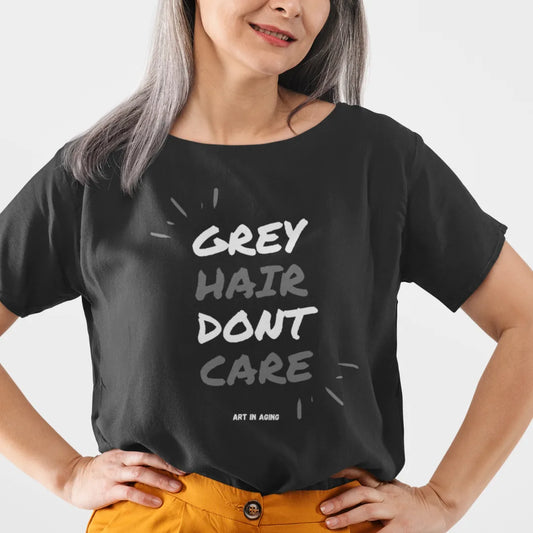
If you're not already connected, join the silver sister movement. Wearing silver sister shirts or just following along with other women's transitions normalizes this phase. You're not being vain or indulgent by wanting your hair to look good while it's growing out. You're investing in something that matters to you. That's worth taking seriously.
Growing out your natural grey is not a test of commitment or a spiritual awakening. It's a practical process with a timeline, and there are concrete things that genuinely speed it along: healthier scalp, better nutrition, less breakage, and smart styling choices. You're also dealing with a visibility shift that takes emotional bandwidth. Combine the physical strategies, get a good cut, know that you're not alone in feeling impatient, and trust the process. In eighteen months or so, you'll have