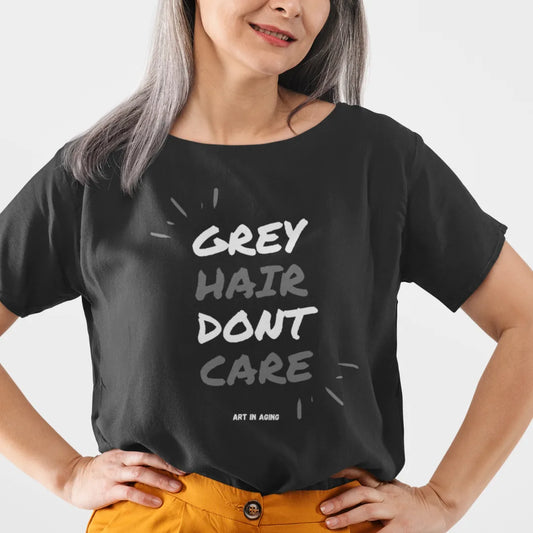
You grew it out. You committed. You stopped dyeing. And now the hair you fought for is going yellow at the top.
Before you blame your shampoo, your stylist, or your hormones — most yellowing has one of five specific causes, and each one has a specific fix. The wrong fix won't work. Here's how to figure out which one is yours.
Why grey hair yellows in the first place
Grey and silver hair has no melanin. Melanin doesn't just give hair color — it also absorbs UV light, repels oxidation, and gives strands a protective layer. When melanin's gone, the hair shaft is exposed: porous, alkaline-leaning, defenseless against anything in the air or water that wants to stick to it.
So yellowing isn't a sign your hair is unhealthy. It's a sign your hair is grey, and grey hair grabs onto everything. The good news: every cause is reversible. The bad news: you have to identify which one is doing the damage before you can fix it.
The five real causes
1. Hard water mineral deposits (the biggest one)
If your house has hard water, iron and copper minerals deposit on the hair shaft every time you shower. Iron oxidizes — it literally rusts — and that rust reads yellow on white hair. Copper deposits give a slight greenish-yellow cast.
How to tell: Test your water with a $5 hard-water test strip from a hardware store. Or simpler signs: soap doesn't lather well, your kettle has white scale, your skin feels filmy after showers. If any of those are true, this is probably 50–60% of your yellowing.
The fix: A shower filter. The Jolie filter ($165) and Aquabliss ($35) both work — Aquabliss is the budget pick that performs almost as well. Screws onto your existing showerhead in 2 minutes. Removes iron, chlorine, and chloramines. Single highest-leverage purchase you can make for grey hair.
Pair it with a chelating shampoo once a month (Malibu C Hard Water Wellness, Ion Hard Water Shampoo) to lift the minerals already in your hair. After 2–3 chelating washes, most of the existing yellow lifts out.
2. UV oxidation
Unpigmented hair has zero defense against sunlight. The keratin proteins break down under UV, releasing yellow byproducts that bind to the cuticle. This is the same chemistry that bleaches wood furniture by a sunny window.
How to tell: Yellowing is worse on the top layer and on the side of your hair that gets sun (left side if you drive a lot, the crown if you walk uncovered). It worsens in summer and after vacations.
The fix: A hat is not optional in summer if you care about your hair color. Wide brim, when possible. For shorter daily exposure, look for hair products with UV filters: Color Wow Travel Companion, Sun Bum Hair Cream. Apply before walking outside.
The damage is also slowed by the right hair oil — argan and marula oils both contain natural UV-protective compounds. They don't replace a hat, but they help on overcast days.
3. Product buildup (silicones especially)
Heavy silicones in conditioners, styling products, and "smoothing" treatments coat the porous grey cuticle and don't fully rinse out. They attract pollutants from the air, oxidize over weeks, and read yellow. The thicker the buildup, the deeper the yellow.
How to tell: Your hair feels coated even right after washing. It's "smooth" but limp. Toning shampoo isn't depositing pigment evenly (because the silicone is blocking it). The yellowing is concentrated on the lengths, not the roots.
The fix: Clarify, then audit your products. A clarifying shampoo once a month (Davines Solu, Briogeo Scalp Revival — both sulfate-free, both effective) strips the buildup. Then read your conditioner ingredient list. If "dimethicone" is in the top five ingredients without "PEG-" or "amodimethicone" qualifiers, that's a non-water-soluble silicone. Swap it.
Look for conditioners with: shea butter, argan oil, panthenol, hydrolyzed proteins. Avoid: heavy silicones, mineral oil, petrolatum.
4. Smoke, pollution, and indoor air
This one surprises people. Cigarette smoke, wildfire smoke, kitchen smoke, exhaust, even particulate from gas stoves — they all deposit on porous grey hair the way they deposit on light-colored curtains. The buildup yellows over weeks.
How to tell: Your hair smells of whatever environment you spend time in (kitchen, smoker, near a busy road). The yellowing is uniform across all your hair, not concentrated in one area. It's worse in winter when windows are closed.
The fix: Two parts. First, the chelating + clarifying approach above will lift what's already there. Second, prevention: rinse your hair with cool water before bed if you've cooked dinner, sat near a smoker, or been outside in heavy traffic. Even 30 seconds of water rinse without shampoo lifts most surface particulate before it has time to bind.
If you cook with a gas stove and have noticed yellowing, an over-stove range hood that actually vents outside (not recirculating) makes a measurable difference over 3–6 months.
5. Chlorine and pool chemistry
Chlorine doesn't just dry hair — it oxidizes the keratin and deposits copper from pool plumbing onto unpigmented strands. The copper is what turns chlorinated grey hair greenish-yellow, the chemistry equivalent of the green statue patina.
How to tell: You swim regularly. The yellowing has a slight green undertone. It's worse after extended pool visits, vacations, beach trips.
The fix: Pre-wet your hair with tap water before getting in the pool — saturated hair absorbs less pool water. Wear a silicone swim cap if you swim laps. After swimming, rinse immediately and wash with a chelating shampoo within an hour. Triswim or UltraSwim shampoos are formulated specifically for pool chemistry and outperform regular clarifiers for this one job.
For occasional swimmers, the fix is post-swim treatment. For daily swimmers, you'll need both a chelating shampoo weekly and a deep-conditioning mask to repair the keratin damage. Olaplex No. 3 or K18 are the two that actually rebuild bonds rather than just coating.
The diagnosis flowchart
If you're not sure which cause is yours:
- Hard water in your home? → Start with a shower filter and chelating shampoo. Solve this first; it's the most common.
- Yellowing worse in summer or one side? → UV. Hat, hair-specific UV product, oil.
- Hair feels coated even clean? → Silicone buildup. Clarify, swap conditioner.
- Smoke/pollution exposure? → Cool rinse routine + clarifying shampoo cycle.
- Swim regularly? → Pre-wet, post-rinse, pool-specific shampoo.
Most silver sisters have two or three of these happening at once. Address the biggest one first; the others get easier once you've stripped the dominant buildup.
What doesn't work (despite the marketing)
Baking soda rinses. Strips minerals but also strips the cuticle. Will dry your hair faster than it'll yellow.
Apple cider vinegar. Lowers cuticle pH temporarily, doesn't address yellow tone, and the smell isn't worth it.
"Anti-yellow" supplements. No oral supplement reaches the hair shaft in time to affect surface yellowing. Save your money.
Generic "purple haircare lines." Most are formulated for bleached blonde, which has different yellowing chemistry than natural grey. The pigment can deposit unevenly on natural grey, creating patchy lavender. Look for shampoos specifically labeled for "natural grey" or "silver hair."
Vinegar + lemon + chamomile DIY rinses. Lighten in unpredictable ways, none of them targeted at yellow specifically. You'll have lighter, drier, still-yellow hair.
The maintenance routine that actually works
Once you've addressed the underlying causes:
- Daily: Sulfate-free moisturizing shampoo (or co-wash 2 days a week)
- Weekly: Purple or blue toning shampoo (3–5 min, depending on your tone)
- Monthly: Chelating or clarifying shampoo to lift residual buildup
- Daily styling: A drop of argan or marula oil on damp ends for shine and UV protection
- Environmental: Hat in summer, cool rinse after smoke exposure, shower filter installed
That's it. Five steps. No miracle products. No $80 toning sprays.
FAQ
Why is my grey hair more yellow at the front? Two reasons: that's where UV hits hardest (you face the sun when you walk), and that's also where hard water hits longest if you bend forward in the shower. Hat + shower filter solves most of it.
Can yellowing be permanent? Surface yellowing always reverses with the right chelating + toning routine. Structural damage from years of chlorine or extreme UV can permanently weaken the keratin, but the color itself comes back to neutral.
How long does it take to remove yellow from grey hair? Visible improvement after 2–3 chelating washes (about 2–3 weeks). Full correction takes 4–8 weeks of consistent routine. Most people see meaningful change within a month.
Does grey hair turning yellow mean it's unhealthy? No. It means it's porous, which all grey hair is. Yellowing is about surface chemistry, not internal health. Healthy grey hair can still yellow if you have hard water.
Why does my grey hair yellow faster than my friend's? Hair porosity varies by genetics. Some people's grey hair has a more open cuticle, which grabs minerals and UV byproducts more readily. There's nothing wrong with high-porosity hair — it just needs more frequent toning and chelating.
Will going to a salon for a gloss treatment help? Yes, in the short term. A salon "demi-permanent toner" or "clear gloss" deposits a thin neutralizing pigment that lasts 4–6 weeks. Useful for special events. Doesn't address the underlying cause though, so the yellow returns.
Can I use chelating shampoo every wash? No — it'll dry out your hair. Once a month for most people, twice a month if you swim or have very hard water. The rest of the time, sulfate-free moisturizing + weekly toning.
What's next
- The actual products: Best Shampoo for Natural Grey Hair
- Toning specifics: Purple Shampoo vs Blue Shampoo: Which One You Need
- Shine and moisture: Best Hair Oils for Grey Hair
- For the science nerds: Grey vs White vs Silver Hair — What's the Actual Difference
Coming soon: a silver-hair care line we'd actually use. Clean ingredients. Made for natural grey hair, not bleached blonde. No purple-bottle marketing. Join the waitlist →
Written by Kirsten Brendst, Writer at Art in Aging. Last updated: 2026-05-25.