From Invisible to Unmistakable: A Silver Sister's Midlife Style Reset
There's a survey from Gransnet that gets quoted a lot: 70% of women say they start feeling invisible around age 52. Walk into a room. The eye slides past you. The waiter looks at the younger person at the table. The clerk talks past your shoulder.
It's real. It also doesn't have to be permanent.
The thing nobody tells you is that "invisible" isn't actually about your age. It's about a culture that trained itself to scan for one thing — youth — and trained you to cooperate with the scan by dressing quieter, smaller, more apologetic every year. Beige. Loose. "Tasteful." Not too much.
You can stop cooperating any time you want.
The cooperation costume
Most women in their 50s have, without quite noticing, assembled a wardrobe designed to not draw attention. It's the closet equivalent of standing against the wall at a party. Lots of grey, navy, taupe. Long hems. High necks. Cuts that don't hug anything. Shoes that don't click.
It feels like good taste. It's actually camouflage. And the deal it offers — be invisible and we won't judge you — turns out to be a bad deal, because the judgment was never the worst part. The worst part was the disappearing.
What "unmistakable" actually means
Unmistakable doesn't mean loud. It doesn't mean trendy. It doesn't mean dressing 25 years younger than you are. It means people can see you coming. There's a silhouette. A color. A choice.
It's the woman in the cobalt coat at the train station. The grey-haired woman in the red lipstick at the farmer's market. The one who walks into the room and you find yourself looking — not because she's "still attractive for her age" but because she's composed. She decided what she looks like. The decision is the look.
Where the reset starts
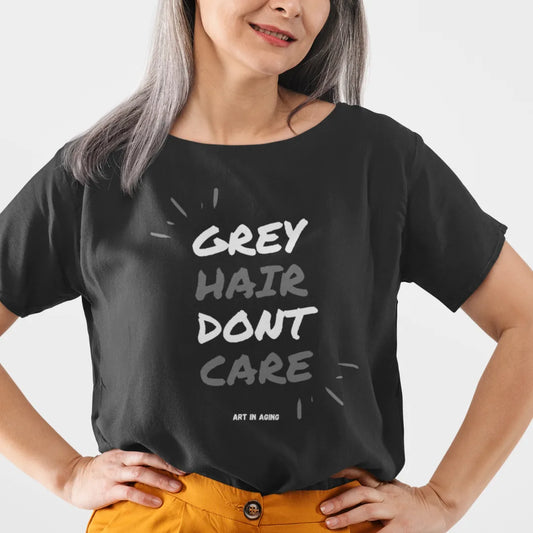
It usually starts at the head. Going grey is the loudest possible refusal of the cooperation costume. You stop spending Saturdays performing youth in a salon chair. You stop pretending the clock isn't ticking. You let your hair tell the truth — and the truth, it turns out, is striking. Silver isn't a surrender. It's a statement other people have to look at.
Once the hair is honest, the clothes have to catch up. The colors that worked when you were a brunette don't work the same way against silver. The hiding pieces start to look like lies. You begin pulling things out of the closet that "feel old" — and realizing it was never the clothes, it was the posture the clothes asked you to take.
Six small refusals that make you visible again
One. Refuse anything beige unless you actively love beige. Beige is the color most often worn by women trying not to be a problem. If you love it, wear it. If you wear it because it's "easy," donate it.
Two. Refuse the long, shapeless layer you bought to "cover up." There's a difference between flowing and hiding. Your eye knows.
Three. Refuse uncomfortable shoes. They keep you small. They keep you home. Visibility requires walking distance.
Four. Refuse "age-appropriate." It's a phrase invented to keep women in line. Dressing your age is not a thing. There is no outfit called 56.
Five. Refuse to apologize for one bold piece. Pick one — a coat, a scarf, a bag, a lipstick — and wear it on a Tuesday with no occasion. The Tuesday is the point.
Six. Refuse the mirror's old job. Stop asking "do I look thin?" Start asking "do I look like me?"
You were never invisible. You were dressed for invisibility.
The shift is small and seismic at the same time. You stop trying to be unobjectionable and start trying to be unmistakable. The room reorganizes itself around you. People start asking where you got that. Strangers smile.
It's not magic. It's not a glow-up. It's the very simple act of putting on clothes that say I'm here instead of clothes that say please don't look. After thirty years of the second message, the first one feels almost embarrassing.
Wear them anyway. The embarrassment passes in about a week. The visibility doesn't.