The Women Who Stopped Dyeing Their Hair and Never Looked Back
A post appeared on Reddit's r/GenX forum not long ago with a simple question: "Anyone else liberated by letting their hair go grey or white?"
It got 1,800 upvotes and over a thousand comments. The thread kept going for days.
That's not a fluke. Across Reddit — in r/AskWomenOver40, r/AskWomenOver50, r/AskWomenOver60, r/TwoXChromosomes — the same conversation keeps erupting, over and over. Women describing the moment they put down the box dye and decided they were done. Women using words like free. Liberated. Like myself again.
So what's actually happening here? And why does it feel so radical to simply let your hair be the color it is?
The Treadmill No One Talks About
Ask any woman who's been coloring her grey for years and she'll describe a rhythm that slowly, quietly took over her life. The six-week countdown. Watching the roots appear — first at the part, then the temples. The mental math of whether she can stretch it one more week. The salon appointments that got more expensive every year ($150, then $200, then $400 and climbing). Or the bathroom floor covered in towels on a Sunday afternoon, waiting for the box color to process.
One woman on r/AskWomenOver50 captured it perfectly when she wrote about suddenly not being able to get her hair to take color anymore after her early fifties: "I'd much rather pay $10 out of the box at home" — and then the dawning realization that the whole enterprise had become something she was doing out of obligation, not desire.
Another woman in that same thread said she'd dyed her hair since her twenties and was now watching the salon prices hit $400 and climb. "What is going on?" she wrote. And the comments flooded in — not with advice on better colorists, but with women gently suggesting: maybe your body is telling you it's done with this.
The pandemic cracked it open for a lot of people. Salons closed. Roots grew. And women who had been on the dye treadmill for decades suddenly had to look at their actual hair for the first time in years. Multiple threads across Reddit document the same moment: "I stopped during COVID and never looked back." "Stopped coloring when WFH during the pandemic and haven't looked back." "It's so freeing."
What the pandemic did, unexpectedly, was give millions of women a forced pause — and in that pause, a lot of them discovered they didn't actually want to get back on.
What Happens When You Stop
The transition isn't nothing. Women in these threads are honest about that. There's the awkward grow-out phase. There's the two-toned look that can last months, sometimes longer. Some women go for a "big chop." Some use ash blonde highlights or lowlights to blend the line of demarcation. Some use a toner or gloss. Some just wait it out with hats and headbands and a lot of deep conditioning.
The products that come up most: purple shampoo (nearly universal — Shimmer Lights and L'Oréal Everpure get mentioned constantly), sulfate-free shampoos, and bond-building treatments because grey hair is drier and more porous. Toning shampoo once or twice a week keeps grey from going brassy or yellow. It's not complicated. Women on these threads make it sound almost easy once they figured out the routine.
But the physical transition isn't really what the conversations are about. What women are talking about, again and again, is what happens on the inside.
"I feel better, stronger, and it gave me the confidence to embrace who I am now."
"I finally got to see what my real hair looks like. Mine is silver with white streaks and my natural ash streaks too. It's beautiful."
"I am the long-hair cool hippie woman now."
"I look every second of my age, but I also feel I look put together and myself."
"I regret not doing it younger."
That last one comes up a lot. Women in their sixties saying they wish they'd stopped in their forties. Women in their fifties saying they're angry they waited so long. Almost nobody says they wish they'd kept dyeing.
The Compliments No One Predicted
Here's something that surprises women who make the switch: strangers stop them. Other women approach them in grocery stores. At restaurants. At the gym. The comments aren't about looking old. They're about looking striking.
"I get more compliments now than when I was dyeing it."
"I love it. I get so many compliments from women and gay men."
"People have stopped me in the street."
Silver catches light in a way that dyed hair doesn't. It has a luminosity — shiny, dimensional, with streaks of white and pearl and steel that no box color can replicate. Women who were terrified their grey would make them invisible report the opposite: they got more visible. They stood out in a sea of same-colored, same-highlighted hair.
The Money
This gets mentioned in almost every thread, and it's not a small thing. Women spending $150 to $400+ every 6–8 weeks suddenly find themselves with real money freed up. For a woman who was spending $250 every six weeks at a salon, going grey saves over $2,000 a year. Some women had been doing this for twenty, thirty years.
One woman described her hair color bill as "highway robbery" and simply stopped paying it. Another said the money freed up felt almost absurd — she hadn't realized how much she'd normalized that expense, how many years she'd spent on it without question.
Why It Feels Radical
A post in r/TwoXChromosomes put a sharp frame on this: "Going grey is so radical." And it kind of is.
Women are swimming against a very specific cultural current. The beauty industry has a vested interest in making sure women see their grey hair as a problem to be solved. Magazines airbrush it out. Anti-aging products are marketed almost exclusively to women. Men go grey and they're called distinguished. Silver foxes. Zaddy. Women go grey and they hear: you look tired. You let yourself go. Don't you want to look your best?
To simply say no thanks to all of that is, in fact, an act of quiet defiance. And thousands of women are doing it every single day.
They're calling each other Silver Sisters. They're posting their grey progress photos. They're cheering each other on through the awkward grow-out and celebrating the final chop. They're building something together — a community of women who have decided that getting older isn't a problem to be chemically managed. It's just life. Their life. And it's allowed to look exactly like it is.
Is It For You?
Nobody is saying you have to go grey. Women who love their color and choose to keep it — that's just as valid. This isn't about what's right. It's about what's chosen. The women in these Reddit threads aren't anti-dye. They're anti-obligation. They stopped when it stopped being something they wanted and started being something they felt they had to do.
If you're on that treadmill right now and you're wondering what's on the other side — that's what's there. A community of women who have gone before you, who swear by their purple shampoo, who are a little bit evangelical about it all because they feel that good about the decision.
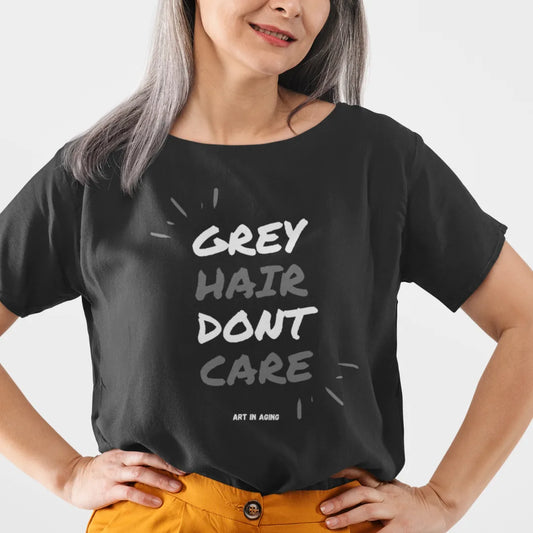
And a lot of them are wearing their silver with pride. Some of them with a t-shirt that says exactly that.
Welcome to the club, whenever you're ready.
Art in Aging celebrates the full, unapologetic life — grey hair and all. Find our Silver Sisters collection and Gone Grey tees in the shop.