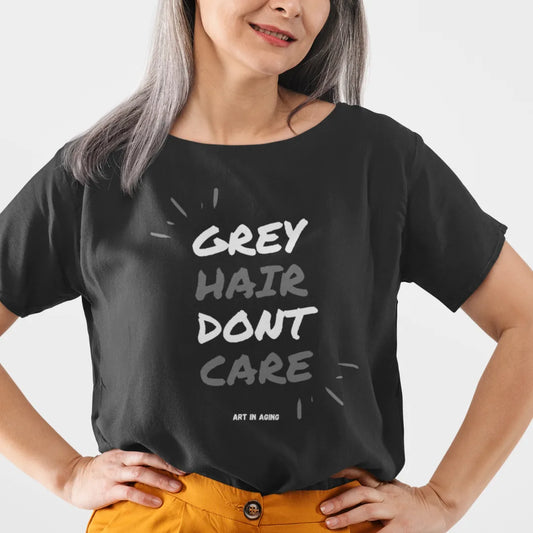
You know the feeling. You're standing in the mirror, looking at your grey roots, and instead of just thinking "I need to book a salon appointment," you feel something heavier. Maybe it's dread. Maybe it's defiance. Maybe it's both at once, which is confusing and exhausting.
The question isn't really "Should I dye my hair or not?" By now, if you're reading this, you probably already know the practical arguments for going grey: it saves time, saves money, saves your hair from chemical damage. You've likely weighed those pros and cons already. The real question—the one that keeps you up at night—is why this decision feels so psychologically loaded. Why does choosing to stop dyeing your hair feel like you're making a statement about your entire life, your identity, and how the world will perceive you from now on?
There's a reason for that feeling, and it's not irrational. It's not vanity. It's psychology—real, legitimate psychology rooted in how we've been conditioned to think about aging, femininity, invisibility, and what it means to "let yourself go." Understanding that psychology is the first step to making peace with whatever decision you make, and maybe even enjoying the process instead of dreading it.
The Cultural Weight of Grey Hair
Let's start with the obvious: grey hair isn't just hair. In our culture, it's a symbol. For decades, it's been coded as a marker of decline, irrelevance, and—let's be blunt—sexlessness. A woman with grey hair is assumed to be past her prime, invisible, done with the project of being attractive. A man with grey hair? He's distinguished. Salt-and-pepper. Authoritative. The double standard isn't subtle, and you've internalized it whether you wanted to or not.
This isn't something you made up in your own head. It's been reinforced by every movie you've watched, every magazine you've flipped through, every commercial you've seen where the only women with visible grey hair are playing someone's mother or grandmother. It's in the language we use: "looking your age" is almost universally considered an insult when applied to women, while "looking good for your age" is the highest compliment we seem to have. The implication is clear: your baseline value decreases with each year, and it's your job to fight that erosion through whatever means necessary.
So when you contemplate transitioning to grey hair, you're not just changing your appearance. On some level, you're rejecting a system of value that's been hammered into you since you were old enough to understand what "pretty" meant. That's psychologically significant. That's why it feels bigger than hair. Because it is.
Identity and the Fear of Becoming Invisible
There's another layer here, and it's worth sitting with: the fear of invisibility. Women report with striking consistency that they become less visible in the world as they age. They're interrupted more in meetings. They're assumed to be less competent. Servers assume they're together with their husbands. Strangers stop looking at them the way they did before. This isn't paranoia. Studies back it up. And grey hair—especially if you're already over 50—can accelerate that shift in how people perceive and treat you.
The anxiety about going grey isn't really about vanity, then. It's about power. It's about the fear that the moment you stop fighting visibly against aging, the world will move faster toward pushing you out of the room. That you'll become the woman people talk over instead of to. That you'll go from being a person they notice to being a person they see through.
This is a legitimate fear based in real social dynamics. And acknowledging that doesn't mean you have to let it run your life. But pretending it doesn't exist—telling yourself you're just being vain if you're anxious about this decision—that's gaslighting yourself. The anxiety is rational. The question is whether you're willing to refuse the premise that invisibility is something you deserve to avoid by erasing evidence of your age.
The Sunk Cost Fallacy (And Why You Might Feel Trapped)
Here's a thought that might hit close to home: you've been dyeing your hair for so long that stopping feels like admitting defeat. Like all those years of appointments and touch-ups and money and time were wasted. Psychologists call this the sunk cost fallacy—the tendency to continue investing in something because you've already invested so much, even when continuing is no longer in your best interest.
If you've been dyeing your hair for 20 years, stopping feels like saying those 20 years were a mistake. And maybe on some level, that's exactly what it feels like, which creates real psychological friction. You're not just deciding whether to dye your hair going forward; you're retroactively judging every choice you made in the past.
Here's the permission you might need: you can have made the right choice for yourself at that time and make a different choice now. The woman who started dyeing her hair at 30 because that's what everyone did, because she needed to feel confident at work, because she wasn't ready to be perceived differently—that woman made a reasonable choice. And the woman you are now, with different circumstances and different priorities, gets to make a different choice. Those two things don't cancel each other out. Time moves forward. You get to change your mind.
The Social Comparison Trap
You've probably looked at other women with grey hair—whether they're celebrities, people in your life, or strangers on the internet—and made snap judgments about whether "it works" for them. Did they age well or age badly? Do they look chic or negligent? This comparison game is relentless, and it's making your decision harder.
The problem is that how grey hair "looks" on someone else tells you very little about how it will look on you. It depends on your skin tone, your natural hair texture, the amount and pattern of your grey, your personal style, the clothes you wear, the confidence you carry. And here's the kicker: it depends on what you decide to believe about it. If you decide that grey hair makes you look old in a bad way, you'll probably read yourself that way in the mirror. If you decide it's a new canvas for a different kind of style, you might find yourself there instead.
This isn't magic thinking. It's the psychological phenomenon of self-fulfilling prophecy, and it's powerful. Your expectations shape your reality more than you might think, especially when it comes to how you perceive yourself in the mirror. That's not to say that negative feelings will just vanish if you think positively—that's toxic positivity nonsense. But it does mean that your mindset going in matters more than the hair itself.
Grief Is Real (Even If You're Choosing This)
Here's something nobody talks about: you might grieve the version of yourself you're leaving behind, even if you're genuinely excited about going grey. Cognitive dissonance is normal. You can simultaneously think "I'm ready for this" and "I'm scared of losing something." You can feel liberated and sad at the same time.
If you've been the woman with the brunette color, or the blonde highlights, or whatever shade you've maintained for years—that's been part of your external identity. Some of your self-image is wrapped up in it. Changing it is a form of loss, even if it's a chosen loss. Letting yourself feel that grief, instead of overriding it with "but it's the right decision," is actually healthier. You don't have to be cheerful about every positive change. You can mourn what you're leaving while walking toward what you want.
The Permission You Actually Need
If you're terrified of going grey, you don't need a pep talk. You need to know that your fear makes sense, and you have more control over how you experience this than you might think. Here's what actually helps:
- Reframe the timeline. You don't have to decide "grey hair, forever, starting tomorrow." You can transition gradually if that feels more manageable. You can try it for six months and reassess. You can dye it back if you hate it. The permanence you're imagining in your head isn't actually there.
- Get practical support for the anxiety. When you stop dyeing your hair, there's a visible transition period. That period can feel exposing. Knowing which products work best for grey hair and what to wear with grey hair can give you concrete things to control when you're feeling out of control.
- Find your people. The silver sister community exists partly for this reason—because doing something countercultural is psychologically easier when you're not alone in it. Seeing other women embrace their grey hair, hearing their stories, understanding that you're not vain or crazy for being nervous about this decision—that matters.
- Separate the hair from the person. Whether you dye your hair or go grey, you're still you. Your worth doesn't live in your hair color. This decision doesn't define you. And while you're getting older, you're not becoming less. The culture might treat you that way, but that's a problem with the culture, not with you.
The psychology of going grey isn't really about the hair. It's about identity, power, visibility, and what it means to refuse to apologize for aging in a world that's built to make you feel like you should. That's heavy stuff. It's okay if this decision feels heavy. And it's okay to take your time with it, change your mind, ask for support, or decide that dyeing your hair still feels like the right choice for you. What matters is that you're making the choice consciously, with full awareness of what you're actually negotiating with yourself—and that you're doing it from a place of honesty, not fear.