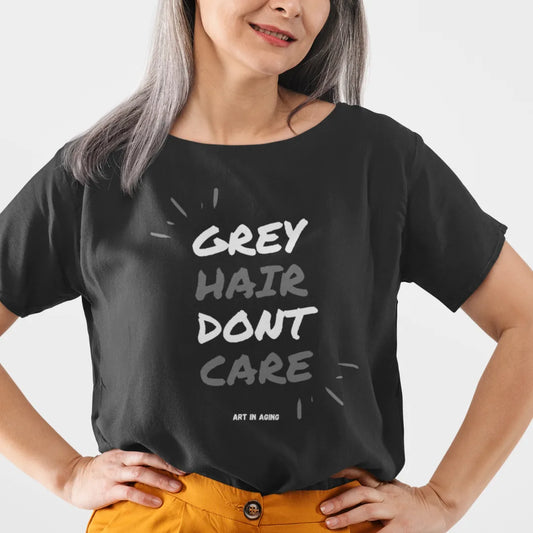
You're at the grocery store, or maybe at work, or standing in line at the coffee shop. Someone—a stranger, an acquaintance, sometimes even a friend—catches sight of your grey hair and the comments start. "You're so brave." "Have you thought about just touching up the roots?" "When are you going to dye it back?" "You'd look so much younger if you colored it." "My mother did that and it aged her ten years."
The comments come with the territory of going grey. Some are well-intentioned. Some are barbed. All of them, regardless of intent, are intrusive observations about your body and your choices—the kind of thing people feel entitled to offer because you've made a visible decision about your appearance.
The question is: what do you do when someone says something about your grey hair that catches you off guard? Do you smile politely and say nothing? Do you snap back? Do you launch into an explanation of why you made this choice? There's no single right answer, but there are strategies that work better than others—ones that don't require you to educate a stranger or shrink yourself smaller to make them comfortable.
The "You're So Brave" Comment
Let's start with the one that sounds like a compliment but often doesn't feel like one: "You're so brave to go grey." This comment carries an implied subtext that what you're doing is unusual, difficult, maybe even a little reckless. It treats the simple act of growing out your natural hair color as though you've just announced you're climbing Everest.
The word "brave" is doing a lot of work here. It suggests that there's something to fear—judgment, looking older, becoming invisible. And while those fears are real and worth acknowledging, the comment frames your choice as courageous in a way that centers everyone else's discomfort rather than your own autonomy.
How to respond: You have options. You can lean into the humor: "Brave? I'm just too lazy to keep up with root touch-ups." You can be direct: "It doesn't feel brave to me—it just feels like my hair." Or you can acknowledge the genuine acknowledgment underneath and redirect: "Thanks. It's felt really good to stop spending money on dye and just let it be what it is." The key is not to over-explain or make the other person feel bad for commenting. A light touch often works best.
The Unsolicited Appearance Advice
This category includes the remarks that come wrapped in false concern: "You'd look so much younger if you colored it." "Have you thought about just doing highlights instead?" "My hairdresser could fix that right up." "Don't you worry that it makes you look tired?" These comments assume that looking younger is your primary goal—or should be—and that your grey hair is a problem in need of solving.
What's particularly frustrating about these comments is that they often come from people who know you, which makes them harder to dismiss as random rudeness. A family member at Thanksgiving. A coworker. A friend's mother. The personal relationship makes the comment feel less like a casual opinion and more like a judgment on your judgment.
How to respond: The boundary-setting response works here. "I appreciate the thought, but I'm happy with my choice" is a complete sentence. You don't need to defend it, explain the money you're saving, or promise that you might reconsider later. If the person presses, you can be a bit firmer: "I've thought about it, and this is what works for me." If it's someone close to you and the comments keep coming, a private conversation might be worth it: "I notice you keep bringing this up, and I want to be direct—I'm not looking for advice on my hair."
The Backhanded Compliment
These are trickier because they're designed to make you question yourself. "Oh, you can pull that off because you have good skin." "Most people your age couldn't do grey hair, but you're different." "It works on you, but it doesn't work on everyone." These comments wrap criticism in a layer of praise, leaving you unsure whether you've just been complimented or insulted.
The function of the backhanded compliment is to make you feel special in your deviation from the norm—which sounds nice until you realize it actually reinforces the norm. The comment is saying, yes, grey hair can work, but only under very specific circumstances, and most people shouldn't attempt it. It's designed to make you feel like the exception, not the rule.
How to respond: You can simply accept the compliment and move on: "Thanks." You can also call out the structure gently: "I think most people could pull it off if they wanted to—it's mostly about confidence." Or, if you're feeling pointed, you can offer a smile and a redirect: "I think everyone looks better when they're doing what they actually want to do." The key is not to let the comment lodge itself in your brain as evidence that you need to be special in order to justify your choice.
The Question Disguised as Concern
Sometimes the comment comes as a question: "Are you sure you're not going to regret this?" "Don't you miss being your natural color?" (This one is particularly absurd, since grey is your natural color.) "What if you wake up one day and hate it?" These questions treat your choice as provisional, something you might need to undo, and they invite you to second-guess yourself in real time.
These comments often come from a genuine place of concern, especially if they're from people who've dyed their hair for decades. They might genuinely not understand that for many women, going grey isn't a temporary experiment but a deliberate shift in how they want to live and present themselves. But understanding the source doesn't obligate you to answer the question or reassure them.
How to respond: You can answer simply: "Nope, I feel good about it." You can turn it back: "Why would I? Are you worried about your own hair?" You can also just acknowledge the concern without taking it on: "I appreciate that you're checking in, but I'm really happy with this choice." And if you're tired or the comment stings, you're also allowed to say nothing and just smile. Not every comment deserves a full response.
The "You Look Older" Observation
This is the big one. The comment that hits at the real anxiety beneath all the others. "You look older now." "The grey really ages you." "I didn't recognize you—the grey makes you look so different." Sometimes it's stated as fact, sometimes as regret, sometimes as a warning.
Here's what's true: grey hair can shift how you look. It might highlight lines on your face or change the way light reflects off your skin. And here's what's also true: you are older. You're the same age you were the day before you stopped dyeing your hair; nothing has changed except that you're now showing it. The comment isn't really about whether grey makes you look older in an absolute sense. It's about whether grey makes you look like an older woman, and older women are supposed to be invisible, forgettable, less-than.
The anxiety in this comment runs deep because it touches on real patterns of how women are treated as they age. Women over 50 do become less visible in many contexts. They do face ageism. These are real problems. But the solution isn't to hide your age; it's to refuse to treat visible aging as shameful.
How to respond: You can be straightforward: "Yes, I look my age now, and that's okay." You can be wry: "That's the idea, actually." You can also use this as an opportunity to push back on the assumption: "I'm not sure that's true, but even if it were, I'm fine with that." If the comment comes from someone whose opinion matters to you, you might add: "My age is real, and hiding it was exhausting. I'm more interested in looking like myself."
When You're Caught Off Guard and Don't Know What to Say
Not every situation calls for a clever comeback or a boundary-setting speech. Sometimes someone says something that lands wrong, and you're left standing there, unsure how to respond. That's okay. You don't owe anyone an immediate answer.
If you want to say something but the words aren't coming, buy yourself time. "I'll have to think about that" or "Interesting" or just "Huh." You can also excuse yourself: "I need to get back to work," "Let me grab my coffee," anything that removes you from the moment. Later, if you want, you can reflect on what would have felt good to say and practice it for next time.
If you find yourself in this situation frequently—at work, in your family, in your social circle—you might benefit from having a few go-to responses ready. Not scripts you have to follow, but options you can pull from when you're tired or uncomfortable. Some women find it helpful to write them down, or to talk through them with the silver sister community, where other women have heard these comments and navigated them themselves.
When the Comment Hits Deeper
Sometimes a comment about your grey hair isn't really about your grey hair. It's about being seen as old, being valued less, losing status in a world that privileges youth. If a partner or family member's comments about your hair feel like part of a larger pattern of criticism or control, that's worth noticing and worth addressing more seriously than a casual remark from a stranger.
Similarly, if you find that comments about your appearance are affecting your confidence in your choice, it might be worth examining where that's coming from. Have you genuinely changed your mind, or are you absorbing other people's discomfort? There's a difference between authentic doubt and internalized pressure. One deserves reflection; the other deserves resistance.
If you're in the thick of grey hair transition and struggling with how you look, that's real too. The early stages can be awkward. Your hair might not feel like yours yet. That doesn't mean the comments are valid, but it does mean you're allowed to feel complicated about it. Many women find that the physical reality of their grey hair catches up to their emotional commitment to it; if that's you, give it time.
The Bigger Picture
Every comment about your grey hair is also, implicitly, a comment about aging. It's a comment on whether visible age is acceptable, whether you should modify yourself to meet other people's expectations, whether your comfort matters more than their comfort with your appearance. The stakes are higher than hair.
This is why your response matters, even to a stranger. When you respond with clarity and calm, you're not just defending your own choice; you're pushing back against the assumption that women should spend their lives making themselves smaller, younger-looking, less threatening to other people's sense of what's normal. You're asserting, with your hair and your words, that your age is not a problem to be solved.
That said, you also don't have to be a educator or activist every single time someone comments on your hair